Table of Contents
ToggleIguana for Sale: The Ultimate Guide to Buying, Caring For, and Owning These Majestic Reptiles in 2026
Introduction
The first time I saw an adult green iguana up close, I was genuinely intimidated. This wasn’t the tiny, bright green lizard I’d seen in pet store photos. This was a four-foot-long dinosaur of a reptile, perched on a branch, watching me with what I can only describe as ancient, judgmental calm. His dewlap flared briefly—a flash of orange and yellow—and he tilted his head as if to say, “You sure you’re ready for this?”
He wasn’t wrong to ask. Iguanas are not beginner reptiles. They’re not even intermediate for most keepers. They are advanced, demanding, long-lived animals that require serious commitment, substantial space, and a willingness to learn from mistakes. But for the right person? They are absolutely unforgettable.
If you’re searching for an iguana for sale, you’ve probably seen those stunning photos of bright green iguanas perched on shoulders or basking in custom enclosures. And yes, those moments are real. But between the baby iguana and that majestic adult lie years of dedicated care, proper nutrition, consistent handling, and the occasional tail whip to remind you who’s in charge.
In this complete 2026 guide, I’ll share everything I’ve learned from keeping and rehabilitating iguanas over the past fifteen years. We’ll cover why iguanas are so challenging, how to find a healthy reptile iguana for sale, setting up a proper enclosure (this is where most people go wrong), feeding schedules, handling techniques, health issues, and even explore some stunning varieties like the Rhino Iguana, Cayman Brac Iguana, and Albino Iguana.
Whether you’re a determined beginner or an experienced keeper looking to add another species to your collection, this guide will give you the honest, practical information you need. Let’s dive in.
Why Iguanas Can Be Rewarding but Challenging Pets
Before we talk about finding an iguana for sale, let’s have a real conversation about what you’re getting into. I’ve seen too many iguanas end up in rescues because owners didn’t understand the commitment.
The Rewards
Iguanas are incredibly intelligent. They recognize individual people. They learn routines. They can be trained to tolerate handling, and some even seem to enjoy human interaction. I’ve had iguanas that would walk onto my arm willingly, that would eat from my hand, that would relax on my shoulder while I worked at my desk.
They’re also visually stunning. A healthy adult iguana in full color—bright greens, oranges, blues—is a living work of art. Their prehistoric appearance, combined with their alert, watchful eyes, makes them endlessly fascinating to observe.
The Challenges
Here’s the reality check. Iguanas grow fast and large. A baby you can hold in one hand will be three feet long in about two years. Adult males can reach five to six feet and weigh ten to fifteen pounds. They need enormous enclosures—think 6’x4’x6′ minimum for an adult.
They have sharp claws, powerful jaws, and tails that can whip with surprising force. A frightened or aggressive iguana can inflict serious scratches and bites. Male iguanas during breeding season can become territorial and aggressive, even toward owners they’ve tolerated for years.
They’re also strict herbivores with specific nutritional needs. Metabolic bone disease is rampant in captive iguanas because owners don’t provide proper UVB lighting or calcium supplementation.
And they live 15 to 20 years with proper care. This is not a short-term commitment.
Who Should Get an Iguana?
-
Experienced reptile keepers
-
People with space for a large custom enclosure
-
Those willing to spend time daily on feeding, cleaning, and handling
-
Someone who appreciates a pet that demands respect
Who should NOT get an iguana:
-
Absolute beginners
-
Anyone without space for a 6’x4’x6′ enclosure
-
People on a tight budget (setup alone costs $1,000+)
-
Those who want a pet they can cuddle
If you’re still reading, let’s move on.
Different Iguana Species and Which Ones Are Commonly Available
When you search for an iguana for sale, you’ll encounter several species. Each has different needs, sizes, and difficulty levels.
| Species | Adult Size | Difficulty | Best Feature |
|---|---|---|---|
| Green Iguana | 4-6 feet | Advanced | Most common, classic appearance |
| Rhino Iguana | 3-4.5 feet | Advanced | Horned snout, stocky build, calmer disposition |
| Cayman Brac Iguana | 2-3 feet | Very Advanced | Rare, unique coloration, critically endangered in wild |
| Desert Iguana | 1-1.5 feet | Intermediate | Small, different care (hot/dry) |
| Spiny-tailed Iguana | 1-3 feet | Intermediate | Faster, more terrestrial |
Green Iguanas are what most people think of when they picture an iguana. They’re widely available, captive-bred, and the species with the most established care information. They are also the most challenging due to their size and potential for aggression.
Rhino Iguanas are stockier, generally calmer, and have that distinctive “horn” on their snout. They’re less common and more expensive but considered by many to be a better “pet” iguana due to their more laid-back temperament.
Cayman Brac Iguanas are rare in captivity. If you find a Cayman Brac Iguana For Sale, expect a very high price and verify captive-bred status carefully—they are protected in the wild.
For most keepers, a captive-bred green iguana is the starting point.
What to Look For When Searching for an Iguana for Sale
Finding a healthy iguana for sale takes patience and knowing what to look for. Here’s my complete buyer’s checklist.
Health Indicators Checklist
-
Eyes: Bright, clear, fully open. No swelling, discharge, or sunken appearance.
-
Skin: Smooth, intact, no lesions, cuts, or stuck shed (especially on toes and tail tip). Color should be bright for the species.
-
Body condition: Rounded but not obese. No visible hip bones or spine ridge. The fat pads on the top of the head should be slightly plump.
-
Mouth: Closed normally. No drooling, gaping, or cheesy material (sign of mouth rot).
-
Vent (cloaca): Clean, no pasty or bloody residue.
-
Activity level: Alert and responsive. Should move away when approached.
-
Tail: Intact and straight. Kinked tails can indicate previous injury or metabolic bone disease.
-
Toes: All toes present. Nipping from cage mates is common in crowded conditions.
Questions to Ask the Breeder or Seller
-
“What’s the hatch date or estimated age?”
-
“Is this captive-bred or wild-caught?” (Only buy captive-bred)
-
“What has it been eating, and what supplements?”
-
“What kind of UVB lighting has it had?”
-
“Have you treated for parasites?”
-
“Can I see the parents?” (For rare species/morphs)
Red Flags to Walk Away From
-
The seller cannot provide a hatch date or origin information.
-
Multiple iguanas are housed together in a small enclosure.
-
The iguana looks thin, has stuck shed, or shows any health issues.
-
The price is suspiciously low (healthy green iguanas: 50−50−150; rare species: 500−500−3,000+).
-
The seller cannot answer basic questions about care.
Captive-Bred vs. Wild-Caught
Only buy captive-bred iguanas. Wild-caught animals are almost always stressed, loaded with parasites, and much more likely to die within weeks of arrival. They also contribute to declining wild populations. A reputable breeder will proudly tell you their animals are captive-bred.
Setting Up the Perfect Enclosure
The number one reason captive iguanas suffer is inadequate housing. Your iguana for sale will grow fast. Plan for the adult enclosure from the start.
Enclosure Size Requirements (H3)
| Age | Minimum Enclosure Size | Recommended |
|---|---|---|
| Baby (0-12 months) | 40-gallon breeder (36″x18″x18″) | 2’x2’x4′ (vertical) |
| Juvenile (1-2 years) | 4’x2’x4′ (vertical) | 6’x3’x5′ |
| Adult (2+ years) | 6’x3’x5′ (vertical) | 8’x4’x6′ or larger |
Critical: Iguanas are arboreal—they live in trees. Height is more important than floor space. An adult green iguana needs at least 6 feet of vertical climbing space.
Substrate Options (H3)
| Substrate | Best For | Pros | Cons |
|---|---|---|---|
| Reptile carpet | Babies/juveniles | Easy to clean, safe | No digging, must clean weekly |
| Paper towels | Quarantine, sick animals | Sterile, cheap | Not natural, no digging |
| Cypress mulch | All ages (especially high humidity) | Holds humidity, natural | Can be sharp, needs replacement |
| Coco coir | All ages | Safe if ingested, holds humidity | Can be dusty when dry |
| Bare floor (tile or PVC) | Adults (simplest) | Easy to clean, no impaction risk | No digging, less natural |
Avoid: Sand (impaction risk), cedar or pine (toxic), walnut shell (sharp, impaction risk).
Hides and Climbing Structures (H3)
Iguanas need vertical space and places to hide. Provide:
-
Thick branches (grapewood, driftwood, or PVC wrapped in rope) that span from bottom to top
-
Platforms or shelves at different heights for basking and resting
-
Cork bark rounds or hollow logs for hiding
-
Artificial or safe live plants for cover and humidity
Safety note: All branches and structures must be extremely secure. A falling branch can injure or kill an iguana.
Lighting and UVB (H3)
This is absolutely critical. Without proper UVB, iguanas develop metabolic bone disease (MBD), which is painful, disfiguring, and often fatal.
-
UVB type: Linear fluorescent T5 HO (10-12%) or mercury vapor bulb (provides heat + UVB)
-
Placement: 12-18 inches above the highest basking perch
-
Coverage: Should span at least 2/3 of the enclosure length
-
Schedule: 12-14 hours on, 10-12 hours off (use a timer)
-
Replacement: Every 6-12 months (UVB output degrades even if bulb still lights)
Do NOT use coil UVB bulbs. They produce inconsistent output and can cause eye damage.
Heating and Temperature Gradient (H3)
| Zone | Temperature |
|---|---|
| Basking surface | 95-100°F (35-38°C) |
| Warm side ambient | 88-92°F (31-33°C) |
| Cool side ambient | 75-80°F (24-27°C) |
| Nighttime | 70-75°F (21-24°C) |
Use a basking bulb (white incandescent) on a dimming thermostat. For nighttime, use a ceramic heat emitter only if temperatures drop below 70°F. No colored bulbs at night.
Temperature Humidity UVB Lighting and Environmental Requirements
Quick reference chart for your iguana setup.
| Parameter | Ideal Range | Danger Zone |
|---|---|---|
| Basking surface | 95-100°F | Above 105°F (burns) |
| Warm side ambient | 88-92°F | Below 85°F |
| Cool side ambient | 75-80°F | Below 70°F |
| Nighttime temp | 70-75°F | Below 65°F |
| Humidity | 60-80% | Below 50% (dehydration/stuck shed) |
| UVB type | T5 linear 10-12% or mercury vapor | Coil bulbs |
| Water bowl | Large, shallow, changed daily | No water source |
Feeding Your Iguana: Diet Supplements and Feeding Schedule
Iguanas are strict herbivores. Unlike bearded dragons, they should never eat insects or animal protein. A high-protein diet damages their kidneys and shortens their lifespan.
Daily Staples (80-90% of diet)
-
Collard greens
-
Mustard greens
-
Turnip greens
-
Dandelion greens
-
Endive
-
Escarole
-
Butternut squash (grated)
-
Acorn squash (grated)
Variety Additions (10-20% of diet)
-
Bell peppers (red, yellow, orange)
-
Green beans
-
Peas
-
Cactus pad (nopales)
-
Okra
-
Parsnips (grated)
-
Carrots (grated, small amounts)
Fruits (Treat Only – Once Weekly or Less)
-
Figs
-
Papaya
-
Mango
-
Berries
-
Banana (very small amount)
Foods to Never Feed
-
Spinach (binds calcium)
-
Kale (small amounts OK, not daily)
-
Iceberg lettuce (no nutrition)
-
Avocado (toxic to reptiles)
-
Rhubarb (toxic)
-
Animal protein (insects, meat, eggs – kidney damage)
-
Citrus fruits (too acidic)
-
Fireflies (deadly toxic)
Supplementation Schedule
| Supplement | Frequency | Notes |
|---|---|---|
| Calcium (without D3) | Light dusting at every feeding | Essential for bone health |
| Calcium with D3 | 1-2 times weekly | Only if UVB is insufficient |
| Multivitamin | 1 time weekly | Prevents deficiencies |
Feeding Schedule
-
Juveniles (under 2 years): Feed daily, as much as they will eat in 20-30 minutes
-
Adults (2+ years): Feed daily, portion size about the volume of their head
Water and Hydration
Provide a large, shallow water bowl (big enough for your iguana to soak in, but shallow enough to prevent drowning). Change water daily. Misting the enclosure 2-3 times daily helps maintain humidity and provides drinking water on leaves.
Handling Temperament and Enrichment Ideas
Iguanas are not naturally tame. Building trust takes months or years of consistent, gentle interaction.
Building Trust
-
First week: No handling. Allow adjustment to new environment.
-
Weeks 2-4: Sit near the enclosure daily. Let the iguana watch you. Talk softly.
-
Weeks 4-8: Open the enclosure and rest your hand inside without moving toward the iguana.
-
Week 8+: Gradually, gently offer your hand for the iguana to approach. Use food as a positive association.
-
Never grab or chase. This destroys trust.
Proper Handling Technique
-
Approach from the side (not from above)
-
Support the entire body, including the tail and all four legs
-
Never grab the tail (it can drop off as a defense mechanism, though iguanas don’t regenerate tails like some lizards)
-
Keep handling sessions short (5-15 minutes initially)
-
Watch for signs of stress: tail whipping, puffing up, darkening of color, hissing, trying to flee
Signs of a Stressed Iguana
-
Darkened color (stress coloration)
-
Puffed-up body (trying to look bigger)
-
Open mouth (defensive display)
-
Tail whipping
-
Hissing
-
Trying to jump or run away
Enrichment Ideas
-
Climbing structures: Add new branches, ropes, or shelves monthly
-
Foraging: Hide food around the enclosure, not just in a bowl
-
Supervised out-of-enclosure time: A secure, iguana-proofed room for exploration
-
Misting: Many iguanas enjoy being misted with lukewarm water
-
Rotating décor: Change the layout every few weeks
Common Health Issues and Preventative Care
| Condition | Signs | Prevention |
|---|---|---|
| Metabolic Bone Disease (MBD) | Soft jaw, tremors, bent limbs, swollen joints | Proper UVB, calcium supplements |
| Respiratory infection | Wheezing, bubbles from nose, open-mouth breathing | Correct temperature gradient, avoid drafts |
| Mites | Tiny black/red specks on skin, excessive soaking | Quarantine new animals, clean enclosure |
| Stuck shed | Retained skin on toes, tail tip, spikes | Proper humidity (60-80%), regular misting |
| Parasites (internal) | Weight loss, runny stool, no appetite | Annual fecal exams, captive-bred prey (none—they’re herbivores) |
| Mouth rot (stomatitis) | Cheesy material in mouth, swollen gums | Clean enclosure, proper temperatures |
| Tail rot | Dark, shriveled tail tip | Early detection, veterinary amputation if severe |
Preventative Care Checklist
-
Daily: Spot-clean enclosure, check water, mist, observe behavior and appetite
-
Weekly: Deep-clean water bowl, wipe glass, check for stuck shed
-
Monthly: Full substrate change, check UVB output, weigh your iguana
-
Annually: Veterinary wellness exam with fecal float
Growth Stages and Long Term Commitment
| Age | Length (nose to tail) | Weight | Notes |
|---|---|---|---|
| Hatchling (0-3 months) | 6-10 inches | 10-30 grams | Very delicate, high humidity needs |
| Baby (3-12 months) | 10-20 inches | 30-200 grams | Rapid growth, handle gently |
| Juvenile (1-2 years) | 20-36 inches | 200-800 grams | Upgrade enclosure, male aggression may appear |
| Sub-adult (2-3 years) | 36-48 inches | 800-1,500 grams | Slowing growth |
| Adult (3+ years) | 48-72 inches | 1,500-5,000+ grams | Full size, breeding possible |
Long Term Commitment
Iguanas live 15-20 years with proper care. Some have reached 25+ years. Before you buy, ask yourself:
-
Do I have space for an 8’x4’x6′ enclosure?
-
Can I afford ongoing costs (veterinary care, UVB bulbs replaced every 6-12 months, fresh produce)?
-
Who will care for this iguana if I travel, move, or become unable?
-
Am I prepared for the potential aggression of a breeding-season male?
Popular Iguana Varieties and Morphs
Many people looking for an iguana for sale are drawn to rare species and color morphs. Here are three impressive options.
Adult Male Rhino Iguana For Sale
The Adult Male Rhino Iguana For sale is a stunning reptile with a distinctive “horn” on its snout. Rhino iguanas (Cyclura cornuta) are stockier, generally calmer, and more terrestrial than green iguanas. They reach 3-4.5 feet and 10-20 pounds. Their coloration ranges from gray to olive green to brownish.
Care note: Rhino iguanas require similar temperatures (basking 95-100°F) and UVB as green iguanas but can tolerate slightly lower humidity (50-70%). They are more terrestrial, so floor space matters more than height.
-
Rarity: Uncommon
-
Price range: 800−800−3,000+
-
Good for beginners? No (advanced only)
Cayman Brac Iguana For Sale
The Cayman Brac Iguana For Sale is one of the rarest iguanas in captivity. This species (Cyclura nubila caymanensis) is critically endangered in the wild, found only on Cayman Brac and Little Cayman islands. Captive-bred individuals are extremely rare and command very high prices. They have beautiful blue-gray coloration with darker banding.
Care note: Cayman Brac iguanas have similar care requirements to other rock iguanas: high basking temperatures (95-100°F), UVB, and a diet rich in leafy greens and vegetables. They need spacious, secure enclosures.
-
Rarity: Extremely rare
-
Price range: 3,000−3,000−8,000+
-
Good for beginners? Absolutely not (only for experienced keepers with CITES documentation)
Albino Iguana For Sale
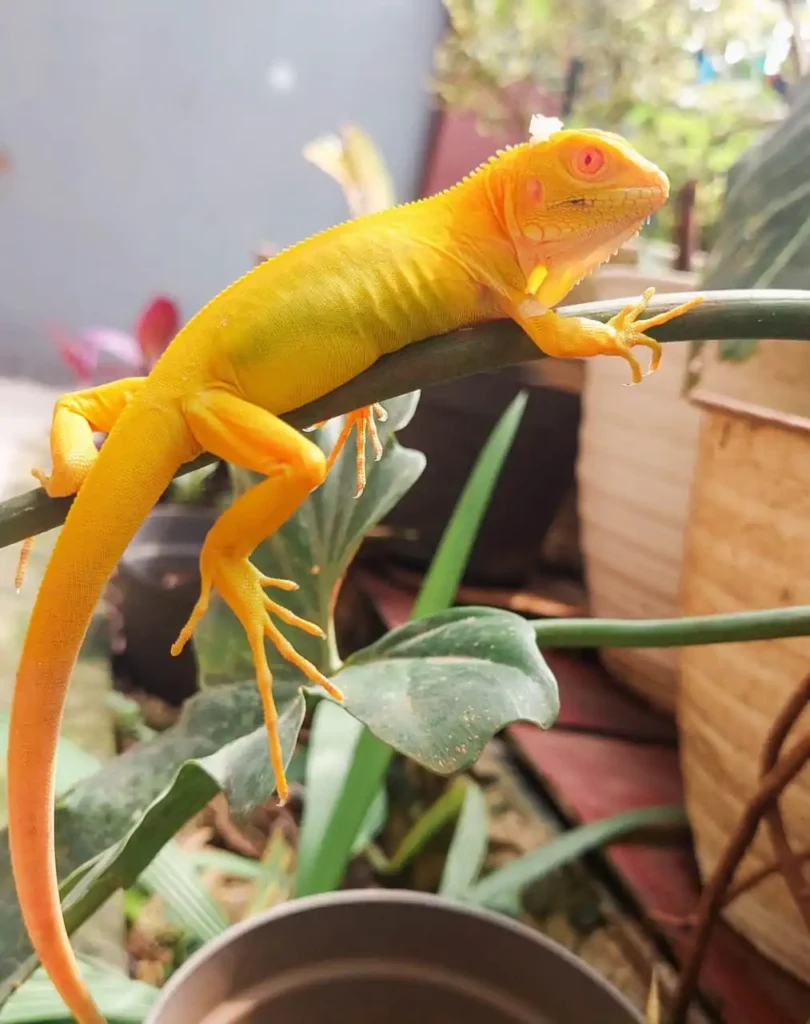
The Albino Iguana For Sale is a striking color morph of the green iguana. Albino iguanas lack dark pigment (melanin), resulting in white, yellow, and orange coloration with pink or red eyes. They are visually stunning but extremely rare and expensive.
Care note: Albino iguanas are more sensitive to bright light due to their lack of eye pigment. Provide plenty of shaded areas and avoid extremely intense lighting. Otherwise, care is identical to standard green iguanas.
-
Rarity: Very rare
-
Price range: 1,500−1,500−5,000+
-
Good for beginners? No (expensive, light sensitivity)
Comparison Table
| Species/Variety | Adult Size | Difficulty | Price Range | Beginner Friendly |
|---|---|---|---|---|
| Green Iguana | 4-6 feet | Advanced | 50−50−150 | No |
| Adult Male Rhino Iguana | 3-4.5 feet | Advanced | 800−800−3,000+ | No |
| Cayman Brac Iguana | 2-3 feet | Very Advanced | 3,000−3,000−8,000+ | No |
| Albino Iguana | 4-6 feet | Advanced | 1,500−1,500−5,000+ | No |
FAQ Section
1. How much does an iguana cost?
The price for an iguana for sale ranges from 50−50−150 for a captive-bred green iguana baby to 800−800−3,000+ for rare species like Rhino iguanas or Albino morphs. The setup (enclosure, lighting, heating) will cost significantly more—typically 500−500−1,500+.
2. Are iguanas good pets for beginners?
No. Iguanas are advanced reptiles that require specific humidity, temperature, UVB, and dietary care. They grow very large (4-6 feet) and can become aggressive, especially adult males during breeding season. Beginners should start with leopard geckos, bearded dragons, or crested geckos.
3. How big do green iguanas get?
Adult male green iguanas typically reach 5-6 feet from nose to tail tip and weigh 8-15 pounds. Females are slightly smaller, 4-5 feet and 5-10 pounds.
4. What size enclosure does an iguana need?
Adult green iguanas need a minimum of 6’x3’x5′ (vertical). Larger is strongly recommended—8’x4’x6′ is ideal. Height is critical because iguanas are arboreal (tree-dwelling).
5. What do iguanas eat?
Iguanas are strict herbivores. They need daily leafy greens (collard, mustard, turnip, dandelion), vegetables (squash, bell peppers, green beans), and occasional fruit as treats. Never feed animal protein.
6. Do iguanas need UVB lighting?
Yes, absolutely. Without UVB, they develop metabolic bone disease (MBD), which is painful and often fatal. Use a linear T5 HO 10-12% UVB bulb or mercury vapor bulb.
7. How long do iguanas live?
With proper care, green iguanas live 15-20 years. Some have reached 25+ years. This is a long-term commitment.
8. Can iguanas be handled?
Yes, but they require patient, consistent handling to build trust. Even tame iguanas may become aggressive during breeding season (especially males). They are not naturally cuddly pets.
9. Do iguanas bite?
Yes. An adult iguana has powerful jaws and sharp teeth. A bite can be serious. Tail whips and claws are also defensive weapons. Respect their space and learn to read their body language.
10. Where can I find an iguana for sale?
From reputable breeders (online platforms like MorphMarket, reptile expos) who can provide hatch dates, feeding records, and health history. Avoid chain pet stores and wild-caught imports. For rare species like an Adult Male Rhino Iguana For sale or Cayman Brac Iguana For Sale, expect waiting lists and higher prices.
11. What’s the difference between a green iguana and a Rhino iguana?
Green iguanas are larger (4-6 feet), brighter green, more arboreal, and generally more challenging in temperament. Rhino iguanas are stockier (3-4.5 feet), gray to olive in color, more terrestrial, and often calmer. Rhinos are also much more expensive and less common.
12. Are albino iguanas harder to care for?
Albino iguanas have the same care requirements as green iguanas, except they are more sensitive to bright light due to their lack of eye pigment. Provide extra shaded areas and avoid extremely intense lighting.
Conclusion
Bringing home an iguana for sale is not a decision to make lightly. These are not beginner pets. They are not cuddly companions. They are large, intelligent, demanding reptiles that require significant space, time, financial investment, and a willingness to learn from mistakes.
But for the right keeper—someone who respects their power, provides for their needs, and appreciates their wild nature—an iguana is one of the most rewarding reptiles on the planet. I’ve had my oldest for over twelve years now. He’s not friendly in the way a dog is friendly. He doesn’t seek affection. But he knows me. He watches me. He tolerates my presence in his enclosure. And on good days, he’ll walk onto my arm and hang out for a while. That trust, earned over years, is worth more than any easy pet.
If you’re ready to take the leap, start by preparing your enclosure first. Spend months researching. Join iguana-specific forums and learn from experienced keepers. And when you finally find a healthy reptile iguana for sale from a reputable breeder—whether it’s a classic green, an Adult Male Rhino Iguana For sale, a rare Cayman Brac Iguana For Sale, or a stunning Albino Iguana For Sale—you’ll know you’ve done the work to give it a thriving home.
Your next steps:
-
Master iguana enclosure setup with our complete equipment guide
-
Find ethical iguana breeders near you or online
-
Download our free iguana care checklist PDF
Your journey with one of the most majestic reptiles on the planet starts with education. Take that step today. Respect the animal. Provide for its needs. And enjoy the wild, unforgettable experience of keeping an iguana. Happy keeping.