Mexican Beaded Lizard: An In-Depth Guide to the Enigmatic Gem of the Reptile World
The Mexican Beaded Lizard, scientifically known as Heloderma horridum, is a creature of profound fascination and stark contrast. It is a living fossil, a venomous jewel, and a challenge for even the most seasoned herpetoculturist. Often overshadowed by its more famous relative, the Gila monster (Heloderma suspectum), the Mexican Beaded Lizard is a larger, more powerful, and arguably more enigmatic reptile. With its striking, bead-like scales and a venomous bite that commands respect, this lizard is not merely a pet; it is a commitment to a specialized form of husbandry that few are truly prepared for. Its rarity, combined with its complex needs and legal restrictions, makes it a “holy grail” for dedicated collectors but a dangerous and inappropriate choice for beginners.
This comprehensive guide will delve into every facet of the Mexican Beaded Lizard, from its prehistoric ancestry and complex venom to the intricate details of captive care, legal hurdles, and the ethical responsibilities of owning one of the world’s few venomous lizards. We will explore its biology, behavior, and the very real considerations that must be weighed before acquiring this “enigmatic gem.”
Part I: The Natural History and Biology of Heloderma horridum
1.1 What is a Mexican Beaded Lizard? A Deeper Dive
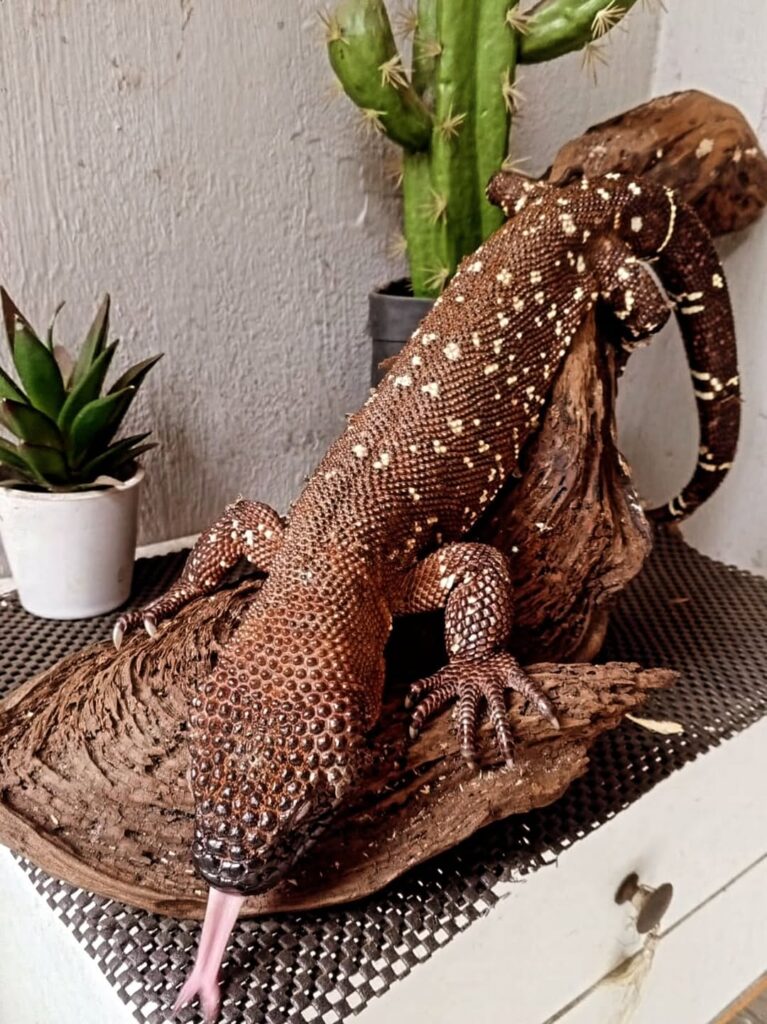
The Mexican Beaded Lizard is a species of venomous lizard in the family Helodermatidae, a lineage so ancient that it predates many groups of snakes and lizards. The name Heloderma translates to “warty skin,” a direct reference to its most distinctive feature: the dorsal scales are not smooth but are large, rounded, and bone-like (osteoderms), giving the skin a characteristic beaded or studded texture. The species name, horridum, meaning “bristly” or “rough,” further emphasizes this unique morphology.
Unlike most venomous reptiles that inject venom through hollow or grooved fangs (like vipers or cobras), helodermatids are the only lizards known to possess a medically significant venom delivery system. Their venom is produced in modified salivary glands located in the lower jaw. Instead of injecting venom through fangs, they bite, hold on tenaciously, and chew, allowing the venom to flow along grooved channels in their teeth and into the wound. This is a primitive but highly effective system for subduing prey and self-defense.
1.2 Physical Characteristics and Morphology
• Size and Build: The Mexican Beaded Lizard is the largest of the helodermatids. Adults typically range from 18 to 22 inches (45-55 cm) in total length, but large specimens can reach 28-30 inches (70-75 cm) and weigh up to 4-5 kg (9-11 lbs). They have a robust, cylindrical body, a thick, muscular tail that serves as a fat storage organ, and short, powerful limbs equipped with formidable claws for digging and climbing.
• The Beaded Skin (Osteoderms): The skin is the lizard’s most defining feature. The scales on the dorsal surface are modified into large, bony osteoderms covered by a layer of keratin. These “beads” are not just cosmetic; they provide a significant degree of armor against predators and physical trauma. The beading is arranged in irregular patterns, creating a mosaic that is unique to each individual, much like a fingerprint.
• Coloration and Patterns: The base color is typically dark brown or black. This dark background is overlaid with a variable pattern of bright, irregular spots, bands, or reticulations. The colors of these markings can range from bright orange and yellow to salmon pink and even white. The extent and distribution of these markings vary not only between subspecies but also between individuals. This aposematic (warning) coloration serves as a clear message to potential predators: “I am dangerous.”
• The Tail: A beaded lizard’s tail is a vital organ. It is disproportionately thick and heavy, acting as a fat reservoir for periods of brumation (reptilian hibernation) or food scarcity. They cannot regenerate their tails like many other lizards, meaning any tail loss is permanent and a significant health setback.
1.3 Geographic Distribution and Subspecies
The Mexican Beaded Lizard is native to the Pacific coast of Mexico and extends into southern Guatemala. They inhabit a variety of arid and semi-arid environments, including deciduous forests, thorn scrub, and rocky canyons, from sea level to elevations of around 5,000 feet.
Four recognized subspecies exist, divided primarily by geographic range and subtle differences in color and pattern:
1. Heloderma horridum horridum (The Beaded Lizard): The nominate subspecies, found from southern Sonora to Oaxaca, Mexico. It is characterized by a bold, contrasting black and orange/yellow pattern, often with well-defined bands or spots.
2. Heloderma horridum exasperatum (The Reticulated Gila Monster): Found in Sinaloa and southwestern Chihuahua. This subspecies often displays a more muted, reticulated pattern of fine orange or yellow lines on a black background, giving it a less contrasting appearance.
3. Heloderma horridum alvarezi (The Riot Beaded Lizard): Confined to the central depression of Chiapas. This subspecies is distinct for having a ground color of jet black with bright yellow or whitish-yellow spots and bands. It is considered the most striking by many collectors.
4. Heloderma horridum charlesbogerti (The Guatemalan Beaded Lizard): Critically endangered and endemic to the Motagua Valley in Guatemala. This is the most threatened subspecies and one of the most endangered lizards in the world. It is of a more uniform dark coloration with only faint yellow or white spots. Its dire conservation status makes it the subject of intense conservation efforts and strict legal protection, making it virtually unavailable in the pet trade.
1.4 Behavior, Ecology, and Life in the Wild
In the wild, Mexican Beaded Lizards are primarily crepuscular and nocturnal, especially during the hot summer months. They are fossorial (burrowing) by nature, spending the majority of their lives in underground burrows or rock crevices, emerging only to hunt, bask, or find a mate.
• Thermoregulation: They are ectothermic and carefully regulate their body temperature by moving between sun and shade. Basking is not a primary activity for them as it is for many desert lizards; they are prone to overheating and prefer moderate, shaded environments.
• Diet and Feeding: As ambush predators and nest raiders, their diet in the wild is surprisingly varied. They feed on small mammals (rodents, rabbits), birds and their eggs, reptiles (including smaller lizards and their eggs), frogs, insects, and carrion. Their powerful jaws and venomous bite are crucial for subduing larger prey. They have a slow metabolism and can go for weeks or months between large meals.
• Activity and Home Range: They are not particularly active animals. Their home range can be relatively small, and they will often reuse the same burrows for years.
• Reproduction: Mating occurs in the spring. After a gestation period of several months, the female lays a clutch of 2-12 leathery-shelled eggs in a carefully excavated nest chamber. The incubation period is exceptionally long, lasting 6-9 or more months. The hatchlings are miniature versions of the adults (about 5-6 inches long) and are venomous from birth.
Part II: Why Are Mexican Beaded Lizards Such a Coveted Species?
The appeal of the Mexican Beaded Lizard goes far beyond simple aesthetics. It embodies several elements that make it a “trophy” species in the herpetological world.
1. The “Apex” of Lizard Keeping: For many experienced keepers, the progression is from beginner species (leopard geckos, bearded dragons) to intermediate (monitors, tegus) and finally to the “advanced” venomous species. The Mexican Beaded Lizard represents a pinnacle of this journey. It is a complex, dangerous, and challenging animal whose successful care requires a depth of knowledge and dedication that few possess.
2. Unrivaled Aesthetic and “Living Fossil” Status: Its prehistoric appearance, adorned with black and orange beads, is unlike anything else in the lizard world. It looks like a creature from another time, which, in evolutionary terms, it essentially is. This primordial connection is a powerful draw for enthusiasts.
3. Rarity and Exclusivity: Beaded lizards are not commonly available. They are notoriously difficult to breed in captivity, and legal restrictions on collection and trade make them a scarce commodity. This rarity fuels their desirability among collectors who seek out unique and uncommon animals.
4. The Challenge and the Prestige: The primary motivation for many is the challenge. Successfully providing a long, healthy life for a venomous, specialized reptile like Heloderma horridum brings a unique sense of satisfaction and prestige within the reptile community. It is a validation of one’s skill and dedication.
Part III: The Crucial Legal and Safety Considerations
This section cannot be overemphasized. The decision to keep a Mexican Beaded Lizard is a decision that comes with profound responsibilities, both legal and ethical.
3.1 The Venom: A Medical Reality
The venom of Heloderma horridum is a complex cocktail of enzymes, proteins, and bioactive compounds. While a bite is rarely fatal to a healthy adult human (no confirmed deaths have been reported in the modern era), it is a serious medical event.
• Composition: The venom contains components that cause intense pain, inflammation, hypotension (dangerously low blood pressure), and edema (swelling). One of the most notable components is helothermine, a peptide that disrupts calcium channels and can cause a variety of neurological effects, including stupor, lethargy, and a sensation of “impending doom.”
• Symptoms of a Bite: Victims describe the pain as immediate, excruciating, and radiating. It has been compared to a “hot knife” being driven into the body. Symptoms can include nausea, vomiting, profuse sweating, rapid heart rate, weakness, and difficulty breathing. The bite is often accompanied by a tenacious grip, making it difficult to dislodge the lizard without causing further injury.
• Treatment: There is no antivenom for Helodermatid venom. Treatment is supportive, focusing on pain management, blood pressure stabilization, and wound care. A bite from a beaded lizard will almost certainly require a trip to the emergency room and potentially a stay in the intensive care unit.
• The “Dry Bite”: Like many venomous animals, beaded lizards can deliver a “dry bite” (a bite without venom injection) as a warning. However, this should never be assumed. Every bite should be treated as a full envenomation.
3.2 Ownership Laws: A Minefield of Regulations
Before even thinking about acquiring a beaded lizard, you must exhaustively research your local, state, and federal laws.
• United States: Ownership laws vary wildly by state and even by city.
• Prohibited: In states like California, Georgia, Hawaii, New York City, and many counties in Michigan, owning any venomous reptile is illegal.
• Permit Required: States like Texas, Arizona, Nevada, and Colorado often require a specific venomous animal permit. These permits can be difficult to obtain, requiring proof of experience, a secure, inspected facility, and liability insurance.
• No Restrictions: Some states, like Alabama, have few state-level restrictions, but local municipal codes may still apply.
• International: The species is listed on CITES (Convention on International Trade in Endangered Species of Wild Fauna and Flora). Appendix II for most subspecies restricts international trade. The Guatemalan Beaded Lizard (H. h. charlesbogerti) is on Appendix I, banning all international commercial trade. Importing or exporting a beaded lizard without the proper permits is a serious federal crime.
• Liability: Even in areas where ownership is legal, you are liable for any harm your animal causes. A bite to a child, a pet, or a guest could result in devastating personal injury lawsuits and potentially criminal charges. Renter’s or homeowner’s insurance may not cover exotic venomous animals, and you will likely need a specialized exotic animal liability policy.
Part IV: The Ultimate Care Guide – Advanced Husbandry for *Heloderma horridum*
This section is for the experienced keeper. It assumes a baseline knowledge of general reptile husbandry.
4.1 Enclosure Setup: A Fortress of Habitat
• Security is Paramount: The enclosure must be 100% escape-proof. This means:
• A solid, lockable top (not a screen lid that can be pushed up).
• All vents and gaps sealed with calk or screen mesh.
• A front-opening design is preferred for access, with secure, lockable sliding glass or swinging doors.
• A double-door system or a lock-out/tag-out procedure for the room is a wise safety precaution.• Size: Minimum for an adult should be 4′ x 2′ x 2′ (120 x 60 x 60 cm). Bigger is always better. A 6′ x 3′ x 2′ enclosure would be ideal for a large pair.• Substrate: They are burrowers. Provide a deep layer (6-12 inches) of a substrate that holds its shape for burrowing. Excellent mixes include:
• 50% Organic topsoil (no fertilizers or perlite), 30% play sand, 20% excavator clay.
• A thick layer of coconut coir mixed with cypress mulch.
• Zoo Med’s ReptiSoil or similar reptile-safe soil mixes.• Furniture: Provide multiple hides, crevices, rock piles (securely stacked, not balanced), and artificial caves. Cork bark rounds, large flat rocks, and slate pieces are excellent. The goal is to create a complex, three-dimensional environment that makes the lizard feel secure.
4.2 Temperature and Humidity Gradients
• Thermal Gradient:
• Basking Area: 88-92°F (31-33°C) using a ceramic heat emitter or a radiant heat panel (not bright lights, which they dislike).
• Cool Side: 70-75°F (21-24°C).
• Nighttime Drop: Allow a temperature drop to 65-70°F (18-21°C).
• Underground Temperatures: Since they burrow, the substrate core should remain at cool-side or room temperature.• Humidity: They need moderate humidity, 40-60%, with occasional spikes to 70% to aid in shedding. This can be achieved by misting a portion of the enclosure or using a reptile fogger. Ensure good ventilation to prevent mold.
4.3 Lighting
Beaded lizards do not require high-output UVB lighting like many diurnal reptiles. However, providing a low-level UVB bulb (e.g., a 2.0 or 5.0 UVB tube) over a portion of the enclosure is still beneficial for vitamin D3 synthesis and overall well-being. A low-wattage heat lamp providing a gentle basking spot is sufficient. A 12-hour day/night photoperiod is essential.
4.4 Feeding: The Delicate Art of the Meal
• Diet: The staple diet in captivity is pre-killed rodents (mice and rats of appropriate size). They can also be offered:
• Quail eggs and whole quail: A great source of calcium and natural enrichment.
• Chicks: Another good source of variety.
• Chubby frogs: A rare treat (can be hard to find).• Feeding Frequency: Their slow metabolism means they do not need to eat often.
• Juveniles: Every 7-10 days.
• Adults: Every 10-21 days. Some keepers feed only twice a month during the active season.
• The “Brumation” Fast: During brumation (a winter cooling period), they will not eat for 2-4 months. This is normal and healthy.
• Feeding Technique: Never feed the lizard from your hand. Use long hemostats or forceps. Drop the food item near the lizard’s head or place it on a feeding platform. The lizard’s feeding response is powerful and fast, and it can easily mistake a finger for a rat. Some keepers feed their beaded lizards in a separate “feeding tub” to avoid associating the main enclosure with food, but this requires careful handling.
4.5 Brumation (Hibernation)
A period of brumation is crucial for long-term health and successful breeding. Over the winter (typically November to February), gradually reduce the photoperiod and temperatures over 4-6 weeks. Stop feeding for 2-3 weeks before cooling to ensure the lizard has an empty stomach. The brumation temperature should be around 55-60°F (13-16°C). Provide a humid hide box so the lizard can hydrate. After 8-12 weeks, slowly reverse the process.
Part V: The Beaded Lizard Market – Price, Availability, and Sourcing
5.1 Price: The Cost of a Legend
A Mexican Beaded Lizard for sale is not a backyard deal. The price reflects its rarity, the difficulty of captive breeding, and the associated legal and logistical costs.
• Typical Range: $800 to $2,500+ USD.
• Juveniles/Sub-adults (Captive Bred): $1,200 • $1,800.
• Captive Bred Adults: $1,500 • $2,500.
• Wild Caught Adults: $500 • $800 (Not recommended).
• Color Morphs/Subspecies: H. h. alvarezi (Riot Beaded Lizard) can often command a premium, especially for a well-patterned specimen.
5.2 Captive Bred vs. Wild Caught: An Ethical and Practical Imperative
You must buy a captive-bred (CB) specimen. Here is why:
• Health: CB animals are not stressed from importation, are free from internal and external parasites, are accustomed to captive life, and are reliably feeding on rodents. Wild-caught animals are often dehydrated, starving, and terrified. They may have severe internal infections and a very high mortality rate in captivity.• Temperament: While never “tame,” a CB animal that has been raised around humans is less likely to be panicked and prone to defensive aggression than a wild-caught one.
• Legality: CB animals are more easily verifiable for legal ownership.
• Conservation: Choosing a CB animal removes the financial incentive to poach wild specimens, contributing to the conservation of already threatened wild populations.
5.3 Finding a Reputable Breeder
Do not buy from online classifieds, reptile forums, or pet stores that are not specialized venomous dealers. A reputable breeder will:
• Freely provide pictures and videos of the specific animal for sale.• Know the exact hatch date, lineage, and feeding schedule.• Answer all your husbandry questions knowledgeably.• Be listed on a venomous reptile breeder directory (like the USARK venomous breeder list or specialized herp society groups).• Not pressure you into a purchase or ship to a location where ownership is illegal.
5.4 Signs of a Healthy Beaded Lizard
Before purchasing, look for these signs:• Clear, bright eyes: No discharge or swelling.• Clean nostrils: No bubbles or mucus.• Clean vent: No signs of diarrhea or pasty urates.• Full, rounded tail: The tail is their fat store, so a thick, plump tail is a sign of good health. A “broomstick” tail indicates emaciation.
– Active and alert: The lizard should be moving willingly, not lying limp. A head-up, alert posture is a good sign.
– Smooth, complete sheds: Look for patchy skin or retained eye caps (spectacles).
– Firm grip: When held (by a professional), it should grip firmly.
Part VI: Common Health Concerns and Veterinary Care
Finding a veterinarian who has experience with venomous reptiles is one of the biggest challenges. You must locate a zoo or exotics vet before you acquire the lizard.
– Respiratory Infections (RI): Caused by low temperatures or high humidity. Symptoms include open-mouth breathing, wheezing, and nasal discharge.
– Parasites: Common in wild-caught animals (nematodes, coccidia). A fecal exam by a vet is crucial for any new acquisition.
– Metabolic Bone Disease (MBD): Rare with proper UVB and calcium supplementation, but can occur from a poor diet.
– Dysecdysis (Bad Shed): Often due to low humidity. Provide a humid hide or gently soak the lizard in shallow, lukewarm water.
– Obesity: An overfed, inactive beaded lizard can easily become obese. The tail will be excessively plump and the body rotund. Regulate feeding strictly.
– Mouth Rot (Stomatitis): An infection in the mouth, often from injury or poor husbandry.
Part VII: The Ethical and Final Verdict
The Mexican Beaded Lizard is not a pet. It is a captive wild animal of immense natural beauty and complexity. It does not desire your companionship or affection. Keeping one is a profound act of stewardship that requires an extraordinary level of commitment.
– The Unpleasant Reality: You will need protocols for a bite. Every feeding, every cage cleaning, every maintenance task is a calculated risk. The lizard is not “mean,” but it is a powerfully built, venomous predator that is easily startled. A mistake can lead to a life-altering medical emergency.
– The Long-Term Commitment: These lizards can live for 30-40 years. Will you still be able to provide for it in 20, 30, or 40 years? What happens to the animal if your life circumstances change? A responsible keeper has a plan for their animal’s entire life, including a contingency plan for its care after their own death.
The Final Conclusion:
The Mexican Beaded Lizard is a spectacular, enigmatic, and deeply rewarding animal for the absolute pinnacle of experienced reptile keepers. It is a creature that commands not just respect, but a genuine, constant, and humble awareness of its power and your responsibility. It is not a beginner’s pet. It is not an intermediate’s pet. It is the final exam for the most dedicated herpetologist.
If, after years of experience with large, powerful monitors and other advanced reptiles, you have the space, the finances, the legal clearance, the secure facility, the medical plan, and the profound dedication required, the Mexican Beaded Lizard can be the crown jewel of a lifetime of herpetological passion. For everyone else, you can best appreciate this living fossil by supporting conservation efforts to protect its dwindling wild habitats.